
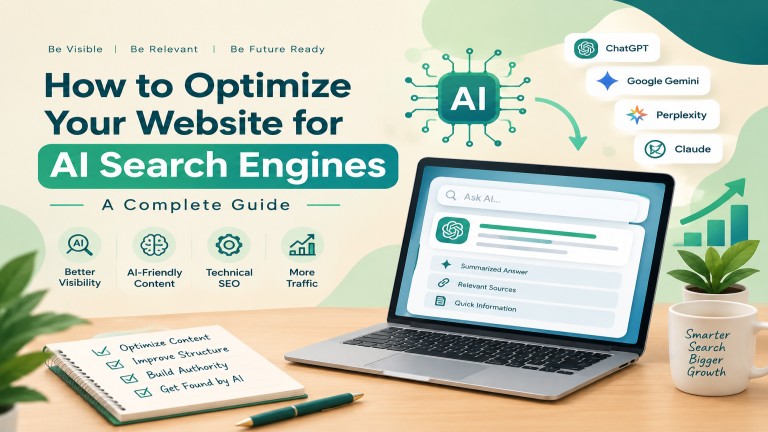
How to Optimize Your Website for AI Search Engines
What Are AI Search Engines? AI search engines use large language models to understand a question’s meaning and intent, then generate a direct, synthesized answer — often pulling from several sources at once — instead of simply listing matching webpages. Traditional search engines work mainly by matching keywords and ranking pages using signals like backlinks, relevance, and page quality. You ask a question, and the engine hands you a list of pages it believes can answer it. AI-powered search works differently. Instead of just matching words, it tries to understand the underlying intent behind a question, connect it to related concepts, and pull together information from multiple sources into one coherent response. This is what people mean by conversational search — you can ask a follow-up question the way you would with a person, and the system remembers the context of what you asked before. Some of the most widely used examples of AI-powered search right now include: Google AI Overviews — AI-generated summaries that appear above traditional search results for many queries. ChatGPT search — a conversational interface that can browse the web and cite sources in its answers. Bing AI search (Copilot) — Microsoft’s AI assistant integrated directly into search results. Other AI assistants and browser-based tools that increasingly answer questions using live web content. For businesses, this matters because being the source an AI system chooses to cite or summarize is becoming its own kind of visibility — separate from, but connected to, a traditional page-one ranking. Why AI Search Optimization Matters for Businesses User behavior is changing faster than most websites are adapting to it. More people are asking full questions instead of typing short keyword phrases, and many are getting the answer they need without clicking through to a website at all. That shift has a few real consequences for businesses: Brand visibility now happens inside AI answers, not just search results. If an AI Overview or chatbot answer mentions your brand or links to your content, that’s a form of exposure even without a click. Fewer clicks can mean more qualified traffic. Visitors who do click through after reading an AI summary are often further along in their decision, which can support better-quality leads. Traditional SEO alone may not be enough. Ranking well in classic search results doesn’t automatically mean an AI system will choose to reference your content in its answer. SEO, GEO, and AEO increasingly work as one strategy. Treating them as separate projects usually just duplicates effort. None of this means traditional SEO is going away — the fundamentals of relevance, authority, and user experience still matter enormously. It means the target has expanded to include how AI systems read and represent your website, not just how search engines rank it. How to Optimize Your Website for AI Search Engines Here’s a practical breakdown of the strategies that genuinely support AI search visibility, based on how these systems actually process and select content. 1. Create Helpful and High-Quality Content AI systems are trained to favor content that genuinely answers a question, so the starting point is always the same: write for the person asking, not for an algorithm. Understand the real intent behind a search before you draft anything, and avoid thin, generic, or copied content that doesn’t add anything new. Use real examples, practical tips, and insights drawn from actual experience in your field — content that shows you’ve actually done the thing you’re writing about tends to hold up better over time. 2. Use Clear and Conversational Language Because so many AI searches start as natural questions, your content should read like it’s answering one. Write in simple, direct sentences, use question-based headings where they fit naturally, and lead with a clear answer before going into detail. This makes your page easier for a person to skim and easier for an AI system to extract a usable answer from — the “lede-first” style used in this very guide is a good model to follow. 3. Organize Your Content with Proper Headings Structure is one of the clearest signals you can give both readers and AI systems. Use a logical hierarchy of H1, H2, and H3 headings, keep paragraphs short, and break up dense information with bullet points, numbered lists, and FAQ sections. A well-organized page is easier to scan for humans and easier to segment for machines trying to pull out a specific answer. 4. Implement Structured Data and Schema Markup Structured data is a standardized way of labeling your content — such as marking a paragraph as an FAQ answer or a page as an Article — so search systems can understand it more precisely. Schema types like Article, FAQ, Organization, LocalBusiness, and Product help clarify what your content actually is. It’s worth being realistic here: structured data doesn’t guarantee AI search visibility on its own, but accurate, valid markup removes ambiguity and makes your content easier to interpret correctly. 5. Build Topic Authority with Semantic SEO Semantic SEO is about covering a topic thoroughly rather than chasing a single keyword. Use related terms and concepts naturally throughout your content, build topic clusters of supporting articles around a core subject, and link related pages together. Over time, this pattern helps demonstrate genuine expertise and topical depth — something AI systems tend to weigh when deciding which sources to trust for a given subject. 6. Improve Website Technical SEO None of the above matters much if AI crawlers and search engines can’t actually access and read your site efficiently. Keep page loading speed fast, design for mobile first, and run your site on secure HTTPS. Maintain a clean site architecture with a proper XML sitemap, sensible internal linking, and pages that are genuinely crawlable and indexable. Accessible content — readable text, proper alt attributes, logical markup — also tends to be easier for AI systems to parse correctly. 7. Add Original Data, Expertise, and Real Experiences AI systems, like human readers, tend to favor sources that feel trustworthy