
Introduction
Search engine optimization (SEO) is changing rapidly, and artificial intelligence (AI) is one of the key drivers of this growth. SEO is no longer confined only to keyword-rich text to appear among the usual blue links. In 2026, search engines will use artificial intelligence to a greater extent than ever before. They will comprehend queries, summarize the key points of documents, identify relevant concepts, and deliver more natural conversational search results. Google’s AI Overviews and AI Mode are excellent illustrations of this development. Google is claiming that classic SEO methods are still effective since they utilize the same core Google Search technologies to find and extract information from websites.
For marketers, businesses, bloggers, and media, this implies that besides keywords, relevant content, search intent, expertise, technical SEO factors, and the user’s overall experience need to be considered.
Let’s discuss the impact of artificial intelligence on search engine optimization in 2026 and how to prepare your business for it.
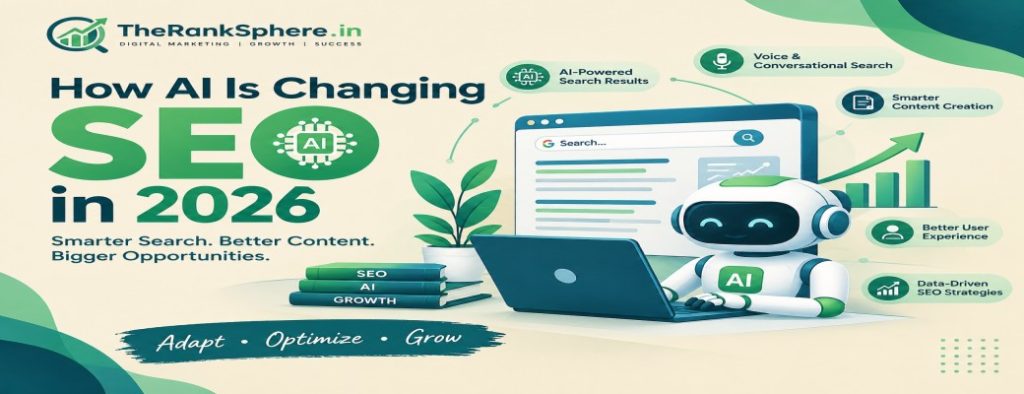
What Is AI SEO?
AI SEO is about harnessing the power of artificial intelligence to optimize various aspects of search engine optimization.
The following are the key areas where AI can be used in SEO:
Assisting with keyword research
Understanding search intent
Planning content
Conducting competitive research
Optimizing content
Technical SEO audits
Internal linking strategies
Updating content
Generating SEO reports and analyzing insights
However, note that search engines are also using AI to better comprehend the contents on websites and the intent of their users.
This means that AI is being utilized in a two-way system; SEO experts are using it to transform their practices, while search engines are using it to enhance their capacities.
Search Is Becoming More Conversational
Many people are starting to ask more detailed and precise questions rather than using simple keywords
For instance, instead of searching
“best digital marketing course”
someone could ask
“What should I learn in digital marketing in 2026 to get a job?”
A search engine can understand and respond to an inquiry based on its context more thoroughly.
AI Overviews and AI Mode Are Changing Search Results
Google’s AI-powered search experiences can provide generated answers along with links to relevant webpages. Google explains that AI Overviews and AI Mode use information retrieved from its Search index to help generate responses and provide links to supporting sources.
This means websites may need to think beyond traditional rankings and create content that clearly answers users’ questions.
However, there is no separate “AI ranking trick” guaranteed to get a website into these experiences. Google states that its existing SEO best practices remain relevant.
AI Is Changing Keyword Research
Traditional keyword research was primarily concerned with search volume, competition, and individual keywords.
AI enables SEO experts to take a step back and look into the following:
Search intent
Related questions
Topic relationships
Long-tail searches
User’s issues
Content gaps
Semantic relationships
Instead of targeting individual search terms, businesses can optimize their topics and create in-depth content that will be found by users looking for solutions to different problems.
Google also confirms that there is no need to attempt to cover every possible variation of a keyword when it comes to generative AI search.
Focus on Search Intent
A successful 2026 SEO strategy is focused on
asking yourself the question: “What can the user actually accomplish on my page?”
A search query can basically be divided into 4 categories:
informational,
navigational,
commercial,
transactional intent.
By focusing on search intent, you can optimize your content in a way that actually provides value to the user instead of just randomly shoving keywords onto a page.
AI Is Transforming Content Creation
AI can help to make content creation faster. Marketers can use AI to brainstorm, plan, summarize, optimize readability, and fill in missing topics.
However, AI-generated content should not be published without human editing.
Google notes that using generative AI is not explicitly prohibited. However, creating large volumes of content with little or no original value may violate Google’s spam policies.
The best practice is to combine
AI, human expertis and original value.
For instance, instead of simply asking an AI to write an article on SEO, you could request additional original examples, expert opinions, personal experiences, case studies, data, unique insights, and recommendations.
Google’s latest guidelines stress the importance of creating valuable and unique content that goes beyond commodity articles that could be created by anyone on the same topic.
Technical SEO Still Matters in the AI Era
AI does not eliminate technical SEO.
Search engines need to crawl, understand, and index your website.
Technical SEO factors include the following:
Website Crawlability
Ensuring that search engine crawlers can access critical pages.
Mobile-Friendly Design
Your website should work properly across smartphones, tablets, and desktops.
Page Experience
Fast loading, clear navigation, readable content, and a good user experience remain important.
Internal Linking
Connect related pages using useful internal links. This helps users and search engines understand the relationship between your content.
Google’s guidance for generative AI search specifically continues to emphasize crawlability, indexing, technical requirements, JavaScript SEO, page experience, and reducing unnecessary duplicate content.
E-E-A-T and Original Content Are Becoming More Important
In an AI-driven content environment, the internet can become filled with similar automatically generated articles.
This makes originality and credibility increasingly important.
E-E-A-T stands for:
- Experience
- Expertise
- Authoritativeness
- Trustworthiness
To improve your content:
- Show who created the content.
- Use reliable sources.
- Include real examples.
- Share first-hand experience when appropriate.
- Keep important information updated.
- Avoid unsupported claims.
The goal should be to create content that people find genuinely useful and trustworthy.
How to Optimize Content for AI Search
There is no guaranteed formula for appearing in AI-generated search results. However, Google’s current guidance provides several practical principles.
Create People-First Content
Write for your audience first—not solely for search engines.
Answer Questions Clearly
Use descriptive headings and provide direct answers before expanding on the topic.
Add Original Information
Give readers something they cannot easily find by reading five other generic articles.
Use Images and Videos
Relevant, high-quality visual content can provide additional ways for users to discover and understand your website.
Maintain Technical SEO
Make sure important content can be crawled, indexed, and understood by search engines.
Importantly, Google says you don’t need special AI-only markup, “LLM files,” or a particular content length to appear in its generative AI search experiences.
AI and SEO Tools in 2026
AI-powered tools can help SEO professionals save time and analyze large amounts of information.
Common applications include:
| SEO Task | How AI Can Help |
|---|---|
| Keyword Research | Find related topics and search intents |
| Content Ideas | Generate topic opportunities |
| Content Optimization | Identify missing sections |
| Competitor Analysis | Analyze competing content |
| Technical SEO | Identify potential website issues |
| Reporting | Summarize SEO performance |
| Content Updates | Find outdated information |
However, AI tools should support your SEO workflow rather than completely replace human judgment.
How to Build an AI SEO Strategy in 2026
A practical AI SEO strategy can follow these steps:
Step 1: Understand your audience
Identify your customers’ problems, questions, and goals.
Step 2: Research topics and search intent
Focus on topics rather than stuffing individual keywords.
Step 3: Create useful content
Provide clear, accurate, original, and actionable information.
Step 4: Add human expertise
Use experience, examples, opinions, case studies, and original research.
Step 5: Optimize technical SEO
Improve crawlability, indexing, website speed, mobile experience, and internal linking.
Step 6: Use AI responsibly
Use AI for research, brainstorming, analysis, and editing—but review and improve the final content.
Step 7: Measure performance
Google introduced a dedicated Search Console view for visibility from generative AI features, including AI Overviews and AI Mode.
The Future of SEO With AI
SEO in 2026 is moving from simply “ranking for keywords” toward becoming visible wherever people search for information.
Search is becoming more conversational, AI-powered, and capable of handling complex queries. Google has also been introducing agentic experiences that can perform tasks on behalf of users, creating another area for websites and businesses to consider.
The fundamentals, however, remain familiar:
Helpful content + strong technical SEO + trust + user experience + original value
AI may change how people search, but websites still need to provide information that deserves to be discovered.
Frequently Asked Questions About AI and SEO
Is SEO still important in 2026?
Yes. Google states that SEO best practices remain relevant for its AI-powered search experiences because these systems rely on core Search and ranking systems.
Will AI replace SEO professionals?
AI can automate and accelerate many SEO tasks, but human strategy, creativity, experience, analysis, and decision-making remain important.
Is AI-generated content bad for SEO?
Not automatically. Google says AI-generated content can be acceptable when it provides value and follows Search Essentials and spam policies. Large-scale content created without adding value can violate Google’s spam policies.
What is AI SEO?
AI SEO means using AI technologies and AI-aware strategies to improve search visibility, content quality, research, analysis, and optimization.
How can I optimize my website for AI search?
Focus on valuable original content, strong technical SEO, crawlability, clear information, good user experience, and genuine expertise. There is no special guaranteed AI-search optimization trick.
Conclusion
AI is changing SEO in 2026, but it is not making SEO irrelevant. Instead, it is changing how SEO professionals research topics, create content, analyze data, and think about search visibility.
The biggest opportunity is not to publish more AI-generated content. It is to use AI intelligently while creating better, more useful, original, and trustworthy content for real people.
If your business wants to succeed in modern search, start with strong SEO fundamentals and use AI as a productivity and analysis tool—not as a replacement for human expertise.
CTA: Ready to Grow Your Website With AI-Powered SEO?
Want to improve your website’s visibility, attract more targeted traffic, and build a stronger digital presence?
Start your AI-powered SEO journey today. Contact us to discuss your SEO strategy and discover how smart SEO can help your business grow, rank, and succeed.