
SEO vs GEO vs AEO: What Is the Difference?
The way of searching has changed and will continue to change significantly. The user no longer searches only on traditional search engines but also uses Google for finding information and asks Google what they want to find. Answers can be found not only on a set of websites but also in direct answers from search engines.
New concepts such as SEO, GEO, and AEO were born due to changes in the way of searching. SEO (Search Engine Optimization), GEO (Generative Engine Optimization), and AEO (Answer Engine Optimization) are three different strategies related to specific purposes.
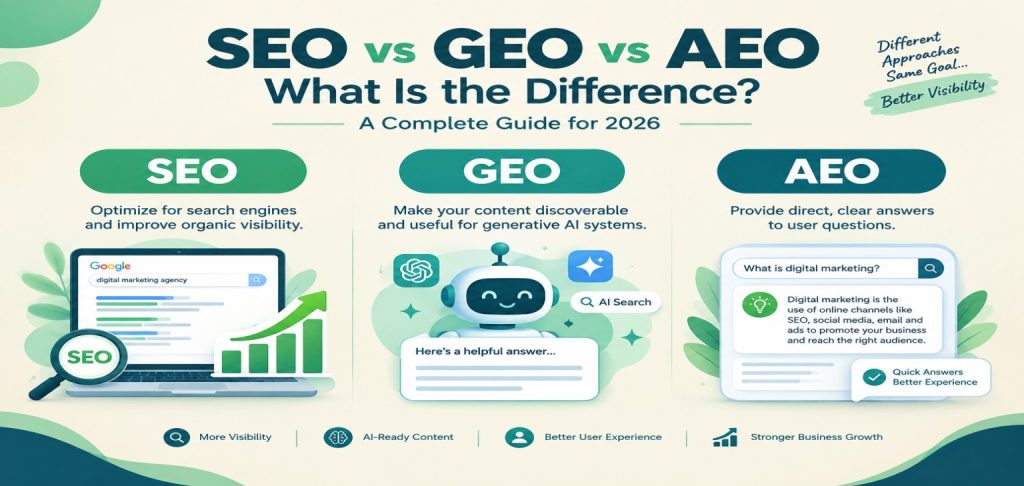
While SEO refers to optimizing a website so that it appears in traditional search engines, GEO is concerned with making content understandable for generative artificial intelligence and getting it included in the search results. On the other hand, AEO focuses on building a knowledge base in such a way that questions posed by users get answered directly.
Therefore, what is the difference between SEO, GEO, and AEO? Which of these strategies should be used by the business?
What Is SEO?
SEO stands for Search Engine Optimization.
It refers to the set of actions required to improve search engine visibility through better discovery, understanding, indexing, and ranking of a website’s pages for relevant queries.
Traditional SEO tactics may involve a combination of the following:
* Keyword research
Provision of useful and unique content
On-page optimization
Technical SEO
Internal linking strategy
Improving website performance and mobile-friendliness
Optimization of images
Schema markup
Acquiring relevant backlinks and mentions
Local SEO
The purpose of SEO is to increase organic visibility and traffic by boosting the page rank in search engine results.
For instance, a digital marketing agency that offers services in India may want their page about “digital marketing agencies in India” to appear when a user types this query. SEO practices will help this company with its organic visibility and traffic.
Google announced that SEO basics remain relevant to its new generative search experiences.
Why Is SEO Still Important?
SEO remains one of the primary tools in digital marketing, as the Internet is where users find products, services, businesses, and information. A properly developed SEO campaign will enable you to
drive high-quality organic traffic,
increase the website’s visibility and attract new visitors,
target those who are interested in your services,
build brand authority,
and generate leads.
What Is GEO?
GEO Stands for Generative Engine Optimization. It refers to a modern practice of optimizing content for the purpose of being found and used by AI-based search and answer systems.
These kinds of systems are different from traditional blue links SEO in that they aim to select and summarize content, as opposed to simply linking to it. For instance, one of the common tools that use such technology is the ability to pull relevant information from different sources and present it as an answer.
When using GEO, your content has to be optimized to be found, understood, selected, summarized, and cited correctly by AI systems.
You can optimize for traditional long-tail SEO keywords, but you would want to go beyond that and aim for creating content that is
easy to understand and consumesis properly structured and supported by facts provides actual value and is original
and addresses specific questions and provides answers that are relevant and easy to extract by both humans and machines.
For instance, you could optimize a page not around a broad topic (“digital marketing”) but rather a specific question and answer (“what digital marketing strategies should a small business use in 2026”) and elaborate on the details, give examples, cite other sources, use relevant definitions and much more.
Does GEO Replace SEO?
GEO should not be treated as a complete replacement for SEO.
Google’s 2026 guidance specifically notes that SEO best practices remain relevant for appearing in Google’s generative AI features.
Think of GEO as an additional consideration for the changing search environment rather than a replacement for established SEO fundamentals.
What Is AEO?
AEO stands for Answer Engine Optimization.
AEO is about optimizing the content to give it an ability to provide direct and useful answers to the users’ questions.
In general, traditional search is about clicking and reading, whereas answer-focused search is about getting information as fast as possible.
For example:
Question: What is SEO?
Answer: SEO is the set of actions of optimizing the website’s visibility in organic search results via content, technical, relevance, and other methods.
SEO content creation is the perfect example of an answer-based search because people are looking for answers to their questions.
How to Optimize Content for AEO
To improve your content for answer-focused searches:
- Identify common questions your audience asks.
- Answer each question clearly.
- Put the answer near the beginning of the relevant section.
- Use descriptive H2 and H3 headings.
- Use short paragraphs.
- Add relevant examples.
- Use lists and tables where they improve understanding.
- Keep information accurate and up to date. However, AEO should not be treated as a completely separate replacement for SEO. Google’s current documentation specifically emphasizes that SEO best practices remain relevant for visibility in its generative AI search features.
Is SEO Dead Because of GEO and AEO?
No, SEO is not deadas search capabilities extend beyond traditional SEO and into new territory that utilizes AI to provide answers to searchers, with Google stating SEO best practices are still relevant to its generative search features.
SEO focuses on making your website easy to find via search,
AEO focuses on making sure your content provides answers directly,
and
GEO focuses on allowing your content to participate in a new type of search experience.
Each of these contribute to a more expansive view of modern search strategies.
SEO vs GEO vs AEO: Key Differences
The easiest way to understand the three concepts is to look at their primary focus.
| Strategy | Main Focus | Main Goal |
|---|---|---|
| SEO | Traditional search engines | Improve search visibility and rankings |
| GEO | Generative AI/search experiences | Increase the chance content is referenced or cited |
| AEO | Answer engines and question-based search | Provide clear, direct answers |
The Future of Search: SEO + GEO + AEO
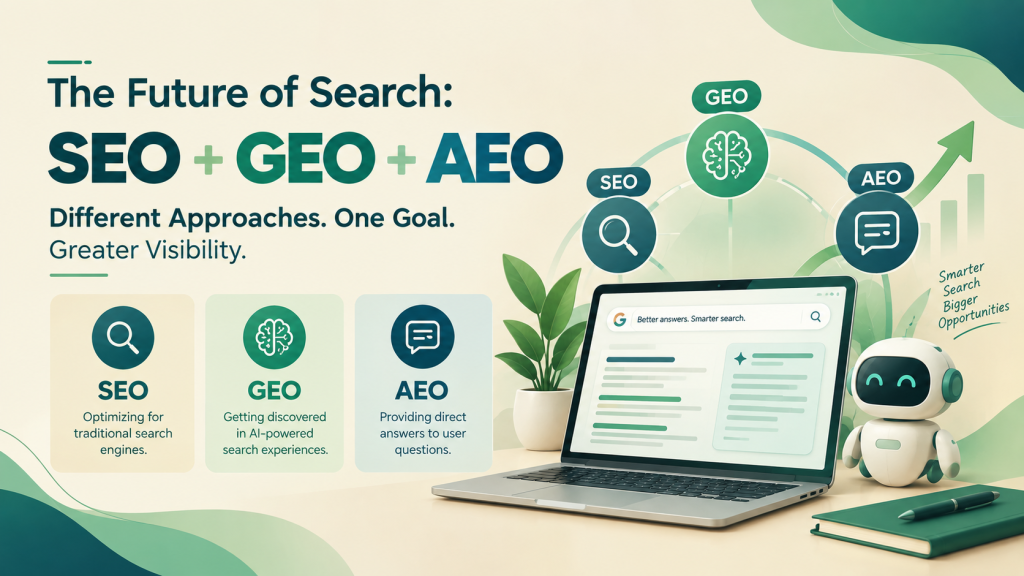
Search is moving from a simple “type → search → click” experience toward more conversational and AI-assisted discovery.
Bing’s recent developments demonstrate this shift, with AI Performance reporting focused on citations and visibility across AI-generated answers.
For businesses, this means that simply publishing large amounts of keyword-focused content may not be enough.
The stronger approach is to create content that is:
Useful + Clear + Accurate + Structured + Original + Trustworthy
That foundation can support visibility across traditional search, answer experiences, and generative AI.
FAQ: SEO vs GEO vs AEO
What is the difference between SEO, GEO, and AEO?
SEO focuses on traditional search, AEO focuses on answering questions, and GEO focuses on visibility and participation in generative AI search experiences
Is GEO replacing SEO?
No, it is not — SEO and other traditional search best practices continue to apply, but marketers should start paying attention to generative AI search experiences
Is AEO the same as SEO?
No, because while they overlap, AEO focuses even more than SEO does on directly answering questions. Good SEO can support AEO efforts, as the two have significant overlap, but AEO also entails creating content that directly and fully answers questions.
Should my business use SEO, GEO, and AEO?
If you have a business that needs to be discovered online, it is likely that you will benefit from building a strategy that incorporates both traditional search engine optimization and emerging AI-powered search opportunities.
How can I optimize my website for AI search?
Begin with strong SEO foundations, create content that provides value, answers questions, and utilizes appropriate formatting, make sure your business information is complete and up-to-date, organize your content and website architecture in a way that is logical and easy to follow, and keep your important pages updated.
Does structured data help with SEO and AI search?
Structured data helps search engines read information on a page and understand what the page is about. Google has its own set of documentation on structured data and how they can be used, though they do not ensure rich snippets in Google Search results.
.
Conclusion
The main difference between SEO vs GEO vs AEO is the way of the appearance of the resource.
SEO is related to classical search engine optimization.
AEO is connected with the response to the user’s questions.
GEO is associated with the participation of a resource in artificial intelligence searches.
However, in the future, it is planned not to oppose the methods of SEO, but to competently combine them with AEO and GEO. Thus, the quality of the company’s online presence can be improved. The three areas of SEO, AEO, and GEO, together with competent technical optimization and high-quality content, will allow you to create an irresistible asset for a brand. If you want to raise the level of your business in the modern digital world of artificial intelligence, it is now the best time to start.