
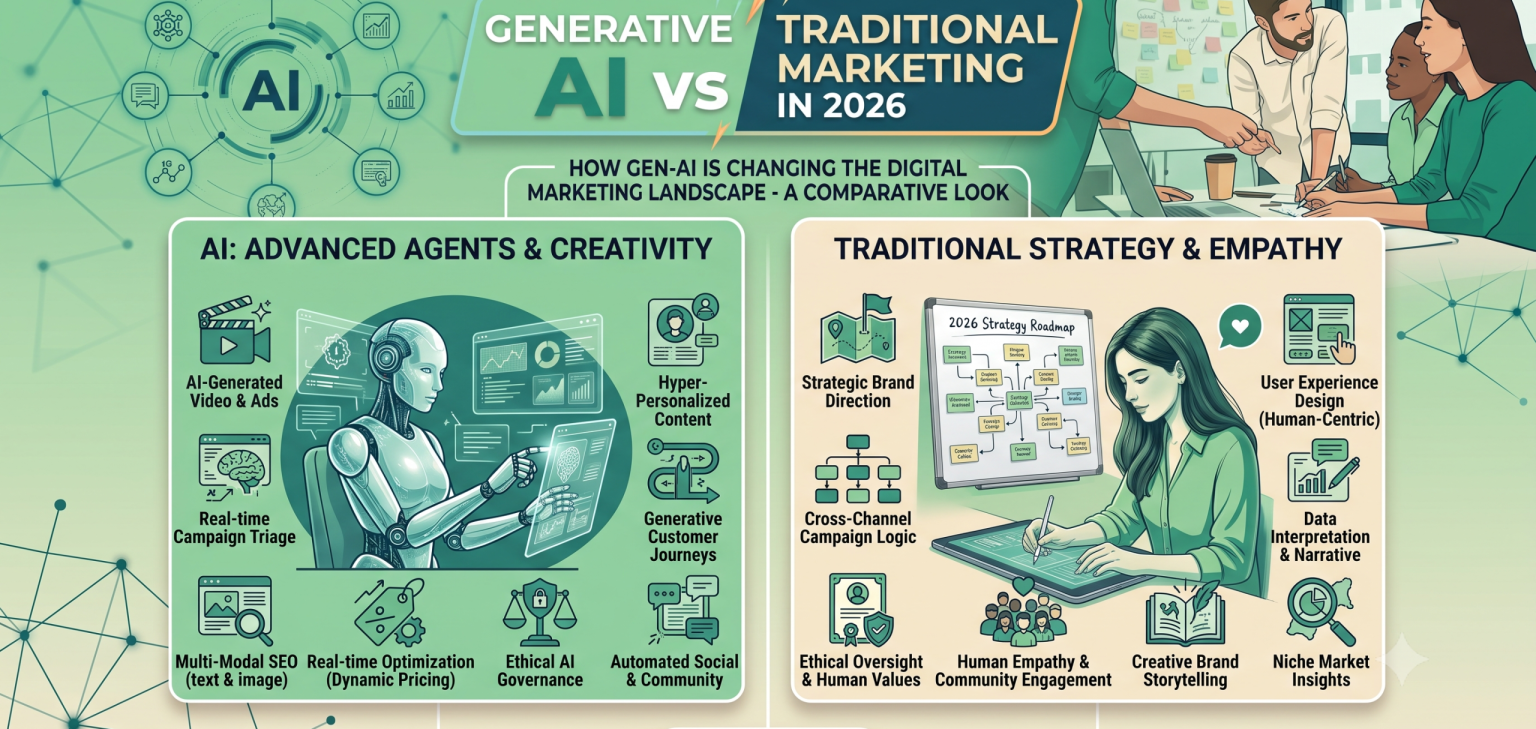
How Generative AI Is Changing Digital Marketing in 2026
While initially an experimental technology, generative AI has now become a crucial tool in contemporary digital marketing. In 2026, marketers use AI in audience research, content creation, ad ideation, data analysis, personalization of customer experience, and optimization of marketing processes.
Marketing platforms have been adding AI to their core offerings as well. For instance, Google has been scaling its Gemini-powered features on Search, YouTube, Google Ads, Analytics, and commerce. Similarly, Meta has been deploying AI throughout its advertising, creative, recommendation, and business messaging offerings.
For brands, all of this translates into faster, more personalized, and data-driven digital marketing.
But generative AI goes beyond creating content based on prompts. The key point here is that marketers use AI to combine creativity, customer intelligence, automation, and decision-making.
Let’s talk about how generative AI is transforming digital marketing in 2026.
What Is Generative AI in Digital Marketing?
Generative AI is a type of artificial intelligence that can create new content based on instructions and available information.
In digital marketing, generative AI can help create:
- Blog posts and articles
- Social media captions
- Email campaigns
- Ad copy
- Images and creative concepts
- Video ideas and scripts
- Product descriptions
- Marketing reports
- Customer responses
- Campaign ideas
However, AI is increasingly being used beyond content generation.
Modern marketing tools can also use AI to identify opportunities, analyze performance, personalize experiences, and support campaign decisions. Google describes this shift as moving from marketing automation toward marketing intelligence.
7 Ways Generative AI Is Changing Digital Marketing in 2026
1. AI Is Transforming Content Creation
Content creation is one of the most visible uses of generative AI.
Instead of starting every piece of content from scratch, marketers can use AI to brainstorm topics, create outlines, generate first drafts, rewrite copy, adapt content for different audiences, and produce multiple variations.
For example, a single blog article can be transformed into:
- Instagram posts
- LinkedIn content
- Email newsletters
- Short video scripts
- Ad copy
- Infographic ideas
This can significantly reduce repetitive work.
However, businesses should not publish generic AI-generated content without review. Human expertise, original insights, fact-checking, brand voice, and editing remain important.
Google has also clarified that its Search spam policies apply to generative AI responses and that content created primarily to manipulate search rankings can violate its policies.
2. AI Is Changing SEO and Search
Search is becoming more conversational and AI-driven.
Google is integrating generative AI into Search experiences, while businesses are also thinking about visibility across AI-powered search systems.
This means SEO is increasingly about more than simply targeting keywords.
Marketers should focus on:
- Helpful and original content
- Clear answers to user questions
- Strong topical coverage
- Search intent
- Structured content
- Trustworthy information
- Technical SEO
- Good user experience
Google’s 2026 Search updates include guidance around generative AI features and preferred sources in AI Overviews and AI Mode.
This is also contributing to the growth of strategies commonly described as GEO (Generative Engine Optimization) and AEO (Answer Engine Optimization).
3. AI Is Making Advertising More Intelligent
Generative AI is transforming the way companies create, manage and optimize online advertising.
Google is introducing AI-powered ad capabilities across Search and YouTube, including solutions to create, generate, optimize, measure and converse with ads.
Marketers can benefit from AI in advertising in several ways, such as:
generating multiple headlines for an ad
coming up with different descriptions
developing creative ideas
identifying audience opportunities
analyzing the performance of a campaign
recognizing areas of improvement
personalizing messages
Google has also unveiled new AI-powered features such as Ask Advisor, which enable marketers to analyze information and take action across its marketing platforms.
This means that instead of spending time on minor tasks related to advertising, marketers can focus on strategic initiatives and decision-making.
4. AI Is Personalizing Customer Experiences
Customers expect businesses to provide relevant information quickly.
Generative AI can help businesses create more personalized experiences based on customer needs, questions, interests, and interactions.
For example, AI can help marketers develop different versions of:
- Landing pages
- Email messages
- Product recommendations
- Advertisements
- Social media content
- Customer communications
AI-powered conversational experiences are also becoming part of advertising and lead generation. Google is testing Business Agent for Leads in India, allowing potential customers to interact with an AI-powered brand agent directly within certain ad experiences.
This can help businesses answer questions before a customer reaches the sales team.
5. AI Is Changing Social Media Marketing
Social media marketers can use generative AI throughout the content creation process.
AI can help with:
- Content ideas
- Captions
- Hashtags
- Short-form video scripts
- Creative concepts
- Content calendars
- Audience research
- Performance analysis
- Content variations
Meta has also been expanding AI capabilities across its platforms, including creative generation, advertising optimization, recommendations, and business messaging.
But AI should not make every brand sound the same.
The strongest social media strategies still need:
Human creativity + brand personality + AI efficiency.
6. AI Is Improving Marketing Analytics
Digital marketers create a lot of data about their websites, ads, social media, emails, and customer interactions.
But this data can be too much to handle.
With generative AI, marketers could leverage insights from all of this data to get actionable and easy-to-understand analyses.
Marketers could rely on AI-driven insights to identify:
• The most effective campaigns
• The most profitable audiences
• The content that resonates
• The acquisition channels
• The customer journey drop-off points
• And other factors that require optimization
Google is also investing in AI and agentic features in Google Ads and Analytics to help marketers discover optimization opportunities and take action faster and easier.
But the critical takeaway is that while artificial intelligence can help analyze data faster, human double-checking and smarter decision-making are still essential.
7. AI Is Creating New Advertising Channels
One of the biggest developments in 2026 is the emergence of AI-native advertising experiences.
OpenAI, for example, has expanded advertising capabilities in ChatGPT, including tools for advertisers and new conversational experiences. Its September 2026 announcement described Sponsored Agents that allow people to start a clearly labeled conversation with a participating business after interacting with an ad.
This represents a different type of customer journey.
Instead of:
Ad → Website → Research → Contact
the journey can increasingly become:
Benefits of Generative AI for Digital Marketing
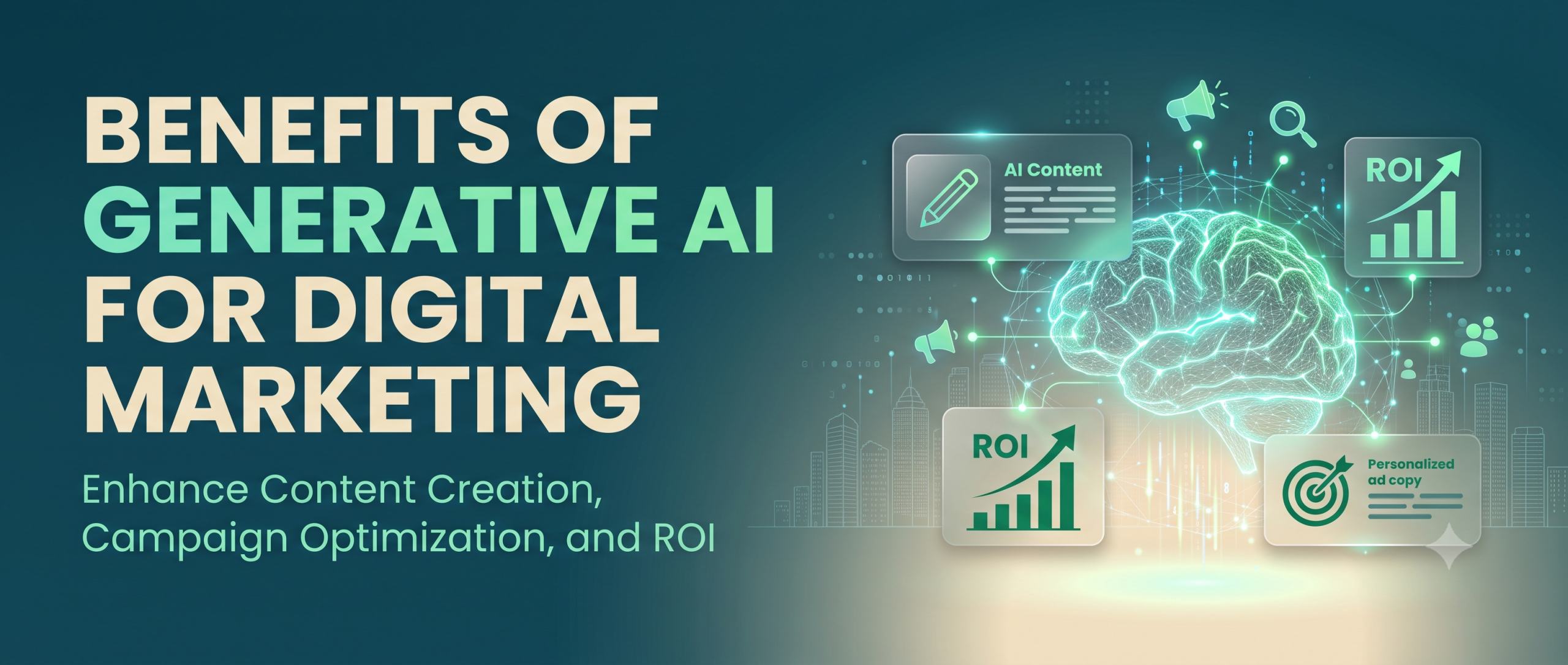
Generative AI can provide several practical benefits when used correctly.
Faster Content Production
AI can reduce the time required for brainstorming, drafting, rewriting, and content adaptation.
Better Personalization
Businesses can create different messages for different customer segments more efficiently.
More Creative Testing
Marketers can generate multiple versions of headlines, ads, images, and messages for testing.
Improved Productivity
AI can automate repetitive tasks and allow marketing teams to spend more time on strategy.
Faster Data Analysis
AI-assisted tools can help marketers interpret large amounts of campaign information more efficiently.
Scalable Marketing
Small teams can potentially produce and test more marketing assets without increasing workload at the same rate.
How Businesses Can Use Generative AI Effectively
Using AI Is No Guarantee of Marketing Success Here’s a suggested process, designed to help you get the most out of your marketing investment in AI: Establish an AI Marketing Workflow Define your objective Before diving into the tools, define what you want to accomplish. For example:
Drive website traffic
Generate leads
Boost social engagement
Increase sales
Reduce ad spend
Understand your audience
Leverage customer insights and existing business data to identify core audience needs, wants and challenges.
Apply AI to repetitive tasks
Use large language models for ideation, initial drafts, variations, summaries, and analysis.
Add human expertise
Ensure that whatever is produced by an AI tool is accurate, appropriate, engaging and on brand. Human review is critical.
Test and measure
Not every AI-generated campaign will succeed. Even if you’re not targeting new customers, measure performance. Results to track might include website traffic, qualified leads, conversions, engagement, cost per lead, and revenue.
The marketing playbook suggested by OpenAI suggests the same approach, including viewing AI as a thought partner and applying human skills to arrive at the best solution.
Common Mistakes to Avoid With AI Marketing
Common Mistakes to Avoid With AI Marketing Mistakes
1. Publishing unedited AI content
Since text created by an AI may contain errors and outdated or generic information, it is essential to review any critical content before posting it.
2. Losing one’s brand voice
While utilizing an AI for writing, a company should not lose its unique message and character that differentiates it from others.
3. Designing content for search engines
One should not create hundreds of articles by using AI for marketing purposes just to fill the website with information.
4. Disregarding data privacy
When implementing AI in a business, one should be aware of the data that is being inputted and ensure that proper security measures are met.
5. Being fully dependent on AI
In cases when AI is used for marketing purposes, companies should not rely solely on technology but rather combine it with human effort, creativity, critical thinking, and responsibility.
Frequently Asked Questions
1. How is generative AI disrupting the digital marketing space in 2026?
Companies are using generative AI for creating content, personalizing marketing initiatives, analyzing data, optimizing advertisements, generating creative assets, and engaging with customers.
2. Can AI take the place of digital marketers?
While AI can assist in several processes, it cannot replace human input and critical thought. Therefor, AI is more likely to be used as an auxiliary tool by human marketers.
3. Can AI help with SEO?
AI can research subjects, comprehend search intent, build content briefs, recognize questions, examine existing content, and even create alternative pieces of content. However, businesses must still generate high-quality material that is informative and optimized with strong technical SEO.
4. Will the contents created by AI be indexed by Google?
The contents created by AI can be indexed by Google if they provide value to the users; however, Google can penalize the websites that use AI for ranking purposes since the search engine wants to avoid low-quality spam content.
5. How can small businesses leverage generative AI for marketing purposes?
Small businesses can utilize generative AI for coming up with social media posts and emails, developing blog post outlines, creating advertisements, designing customer FAQs, carrying out competitor research, generating reports, and reusing content.
6. What is the most significant advantage of AI marketing?
Marketers can achieve greater efficiency by leveraging AI to carry out some of the monotonous and repetitive tasks in the marketing field.
Conclusion
Generative AI is set to redefine digital marketing in 2026, driving it into an era of smart, personalized, scalable and data-intelligent marketing.
From content creation and search engine optimization (SEO) to social media, advertisements, analytics, and customer relational tools – AI appears poised to touch every aspect of the marketing mix.
But effective AI marketing requires striking a balance between automation and art – between algorithms and analysis, and between innovation and intuition.
Marketers who embrace the power of generative AI – while also recognizing its limitations – will find themselves well-positioned to unlock unprecedented gains in content productivity, idea generation, customer insight, and overall marketing agility.
The future of marketing does not lie in an either/or proposition of AI versus humans. Instead, it is about human-AI collaboration and co-creation that unlocks true marketing excellence.