
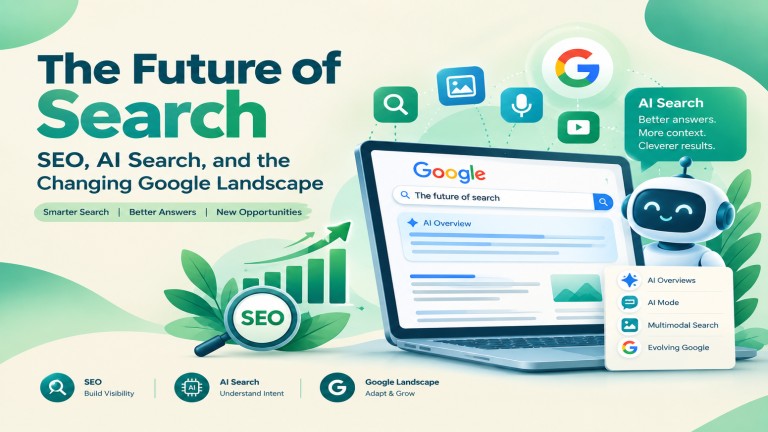
The Future of Search: SEO, AI Search, and the Changing Google Landscape
Search is changing faster than ever.
For many years search was relatively simple: a user would type a keyword into Google, get a list of links and click around to find an answer.
This is now changing, as Google Search now includes AI-powered experiences, conversational queries, visual search and more ways to find information. Google has also released AI Overviews and AI Mode, and Search Console is evolving its reporting so that website owners have insights into the performance of their website across new search experiences.
It does not mean that SEO is dying, but rather, what constitutes a good SEO is now much broader.
Businesses now need to think about traditional search visibility, AI answers, user intent, content quality, brand authority and a range of different search behaviours.
What Is Changing in Search?
The biggest change is that search is becoming more conversational, answer-focused.
Rather than searching:
“best digital marketing strategies”
a user might ask:
“What digital marketing strategies should a small business use to generate more customers in 2026?”
An AI-powered search can then help provide information organized around the user’s specific question.
This provides a different search experience from the traditional list of links.
Search is also becoming more multimodal. Google announced in September 2026 that Search Console reporting now includes data from web multimodal searches such as Google Lens, Circle to Search, image uploads, and “Search this image.”
For businesses, this means search optimization is no longer only about text and keywords.
The Rise of AI Search
AI search is powered by artificial intelligence to comprehend questions, pull information from, and generate or organize answers.
Instead of pulling together keywords and links to relevant web pages like traditional search engines, AI-powered systems can have an understanding of the context and combine information from multiple sources.
Google’s AI search experiences are a critical part of this transition.
Google AI Overviews
AI Overviews can provide an AI-generated overview of information for eligible searches.
The user can then explore supporting sources or continue searching.
Google AI Mode
AI Mode provides a more conversational search experience, allowing users to explore topics through follow-up questions and more detailed interactions.
Google’s documentation now includes specific guidance for websites appearing in its generative AI search features and notes that established SEO practices continue to be relevant.
This is important for businesses because AI search does not eliminate the need for quality websites.
It increases the importance of having content that search systems can understand and users can trust.
Is Traditional SEO Dead?
Traditional SEO is not disappearing.
In fact, Google continues to recommend following fundamental SEO practices for its generative AI search experiences.
The difference is that SEO is becoming more focused on quality, relevance, helpfulness, and user intent rather than simply targeting a keyword.
Traditional SEO still includes:
- Keyword research
- Search intent
- Technical SEO
- Crawling and indexing
- Internal linking
- Website performance
- Mobile usability
- Helpful content
- Structured data
- Relevant links and mentions
- Local SEO
These fundamentals provide the foundation for visibility in search.
The future is not SEO vs AI Search.
It is increasingly SEO + AI Search.
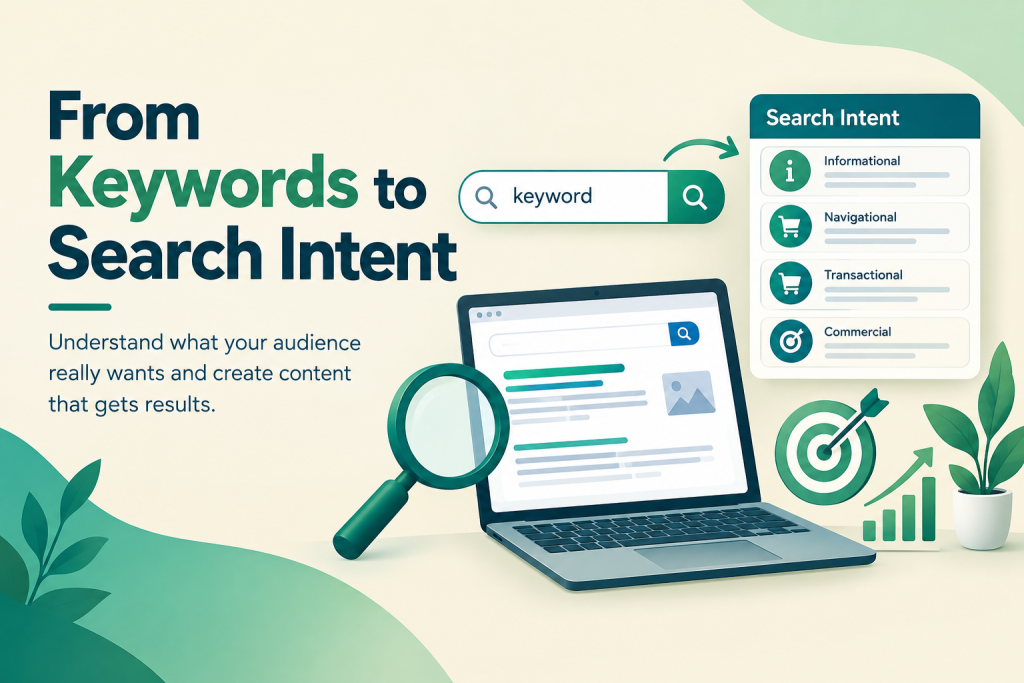
From Keywords to Search Intent
One of the key changes to SEO practices that marketers must understand pertains to the shift from keyword-focused practices to addressing the intent behind the search.
Previously one could focus on developing content around one particular phrase, such as:
“digital marketing services.”
However, today, it is more important than ever to target the actual objective of the searcher, such as:
Do they want to hire an agency?
Are they searching for a way to compare different players?
Do they seek to gain more information on marketing?
Are they interested in the cost?
Can they get leads?
Is a local agency of interest?
By doing so, companies are better at addressing the needs and concerns of potential clients.
Example
Instead of developing a short article focused on the phrase:
“SEO agency,”
create an extensive guide for “how to choose SEO agency for small business 2026”
covering all of the above questions and providing answers and solutions for each of the concerns.
The Growing Importance of GEO and AEO
The changing search landscape has also led to increased interest in GEO and AEO.
What Is GEO?
GEO stands for Generative Engine Optimization.
It refers to approaches designed to make content useful and understandable in generative AI search experiences.
What Is AEO?
AEO stands for Answer Engine Optimization.
It focuses on providing direct and useful answers to questions.
These concepts overlap with traditional SEO.
For example, a well-optimized page can:
- Target relevant search intent
- Answer important questions
- Use clear headings
- Provide original information
- Explain concepts clearly
- Include useful examples
- Demonstrate expertise
- Make information easy to understand
The important point is that businesses don’t necessarily need three completely separate strategies.
A strong content strategy can support SEO, AEO, and AI search visibility together.
Content Quality Will Matter More Than Content Quantity
Generative AI has made content creation much faster.
A marketer can now create dozens of articles, social posts, emails, and other assets in a fraction of the time.
But producing more content does not automatically produce better results.
Google’s spam policies apply to attempts to manipulate both traditional search results and generative AI responses.
This makes quality increasingly important.
Businesses should focus on creating content that is:
- Original
- Accurate
- Useful
- Well-researched
- Relevant
- Easy to understand
- Written for people
- Supported by genuine experience
The New Content Formula
Instead of:
More AI content = More traffic
think:
Better information + Real expertise + Strong SEO + User value = Sustainable search visibility
Search Is Becoming Multimodal
Search is no longer limited to typing words into a search box.
Users can increasingly search using:
- Text
- Images
- Cameras
- Voice
- Videos
- Conversational questions
Google’s September 2026 Search Console update specifically added reporting for web multimodal searches, including Lens, Circle to Search, image uploads, and image-based searches.
This creates new opportunities for businesses.
How Businesses Can Prepare
Optimize more than just your written content.
Consider:
- Original images
- Descriptive image filenames
- Useful image alt text
- Video content
- Product images
- Infographics
- Visual explanations
- Structured data
- Strong page context
For visual businesses, e-commerce websites, restaurants, travel companies, and local businesses, multimodal search can become particularly relevant.
Brand Authority Will Become More Important
As search becomes more AI-driven, being mentioned and recognized as a credible source can become increasingly valuable.
A website should not exist only to rank for keywords.
It should establish a recognizable brand.
Businesses can strengthen their online presence through:
- Original research
- Expert articles
- Case studies
- Customer reviews
- Author information
- Industry contributions
- Consistent branding
- Relevant third-party mentions
- Strong social presence
Google also provides a “preferred sources” feature that can allow users to select publications they want to see more prominently, including in AI Mode and AI Overviews where available.
This reflects a broader trend toward users developing relationships with trusted sources rather than relying only on generic search results.
How to Prepare Your Website for the Future of Search
1. Build a Strong SEO Foundation
Make sure your website can be crawled, indexed, and understood properly.
Focus on:
- Technical SEO
- Site structure
- Page speed
- Mobile experience
- Internal linking
- Metadata
- Structured data
2. Create Helpful Content
Answer real questions from your customers.
Don’t create content simply because a keyword has search volume.
3. Cover Topics Deeply
Build topic clusters instead of publishing unrelated articles.
For example, a digital marketing agency could create a content cluster around:
SEO → AI SEO → GEO → AEO → AI Search → Content Marketing
4. Optimize for Questions
Include questions your customers actually ask.
Give direct answers before providing deeper explanations.
5. Add Original Insights
Use your own examples, experiences, data, processes, and case studies whenever possible.
6. Optimize Visual Content
Don’t ignore images, videos, and other visual formats.
Search is becoming increasingly multimodal.
7. Monitor Search Console
Search Console can help you understand how your website performs in Google Search and newer search experiences. Google is continuing to expand its reporting capabilities as Search evolves.
8. Keep Updating Your Strategy
Search is changing continuously.
A strategy that works today may need adjustment as search interfaces, user behavior, and AI capabilities develop.
The Future of SEO: What Businesses Should Expect
The future of SEO will likely evolve beyond just vying for a spot on the traditional search results page into a consideration of being found at all stages of a search.
Customers could find businesses from:
Google search → AI overview → Website → Social media → Video → AI conversation → Conversion
And so, businesses will need to think beyond optimizing single web pages and instead focus on their wider digital presence.
SEO will continue to matter, but effective search marketing will increasingly blend:
SEO + Content + AI Search + Brand Authority + UX + Multimodal Content
Frequently Asked Questions
1. What is the future of search in 2026?
The future of search is conversational, AI-powered, multimodal, intent-focused, and more, but traditional search remains important, and AI-powered search experiences add new ways for people to discover information.
2. Is SEO still important in 2026?
Yes, Google continues to say that SEO best practices are valuable for their generative AI search features.
3. What are Google AI Overviews?
google ai overviews are AI-powered summaries that may appear for certain queries and give users an overview of information and links.
4. What is Google AI Mode?
AI Mode is a more conversational Google Search experience that enables deeper dives into topics and question-answering.
5. What is GEO in SEO?
GEO (or Generative Engine Optimization) seems to be a term used for approaches to make content findable and useful in the context of generative AI search.
6. How can I optimize my website for AI Search?
Focus on traditional SEO fundamentals, create valuable content, answer questions, demonstrate expertise, ensure technical accessibility, and optimize text, images, video, and structured data for AI processing.
7. Will AI replace traditional Google Search?
AI is reimagining Google Search, but classic search results are still part of the overall search experience. The trend appears to be toward a mix of traditional and AI-powered search results.
Conclusion
The future of search is not only about the evolution of Google as we know it, and the potential replacement of the search giant by an AI alternative.
It’s about discovery, understanding, comparing, and interacting with information and media in new ways.
As such, in 2026 businesses must think past conventional SEO and invest in a wider search ecosystem.
While solid SEO will still be vital, helpful content will continue to thrive, new discovery opportunities will be opened up by AI searches, multimodal interactions will diversify the ways in which people engage with information, and strategic building of brand authority will make companies more recognizable.
Those that move beyond the mere prioritization of search terms and invest in the search space as a whole will see the greatest rewards.
The future of search is not about only optimizing for engines – it’s about people, queries, experiences, and the changing landscape of research as a whole.